
Choosing an Industrial Ventilation Fan in 2026 starts with the air, not the catalogue. What must the system remove: heat, moisture, dust, fumes, or ordinary stale air? A workshop with welding stations has different needs from a greenhouse or warehouse. Measure the room, identify the contaminant, and estimate the required airflow before comparing models. Guesswork can lead to noisy equipment, weak extraction, or wasted energy.
The right fan depends on more than its advertised capacity. Check airflow at the system’s actual static pressure, since ducts, bends, filters, and grilles add resistance. Review fan type, motor efficiency, sound levels, materials, maintenance access, and controls. A corrosion-resistant housing may matter in a damp process area; a compact axial fan may suit a short, open air path. Details matter.
In 2026, variable-speed controls and connected monitoring may help match ventilation to changing demand, but they are not automatic upgrades. Their value depends on the process, operating schedule, and available maintenance skills. Compare manufacturer performance data, confirm installation conditions, and ask a qualified ventilation professional to review safety-critical applications. Local requirements can vary, too.
There is no universal best fan. That is the honest part. This guide explains how to define the duty, assess operating costs, compare specifications, and avoid common selection mistakes. Some project details will remain uncertain until the system is measured in the field.
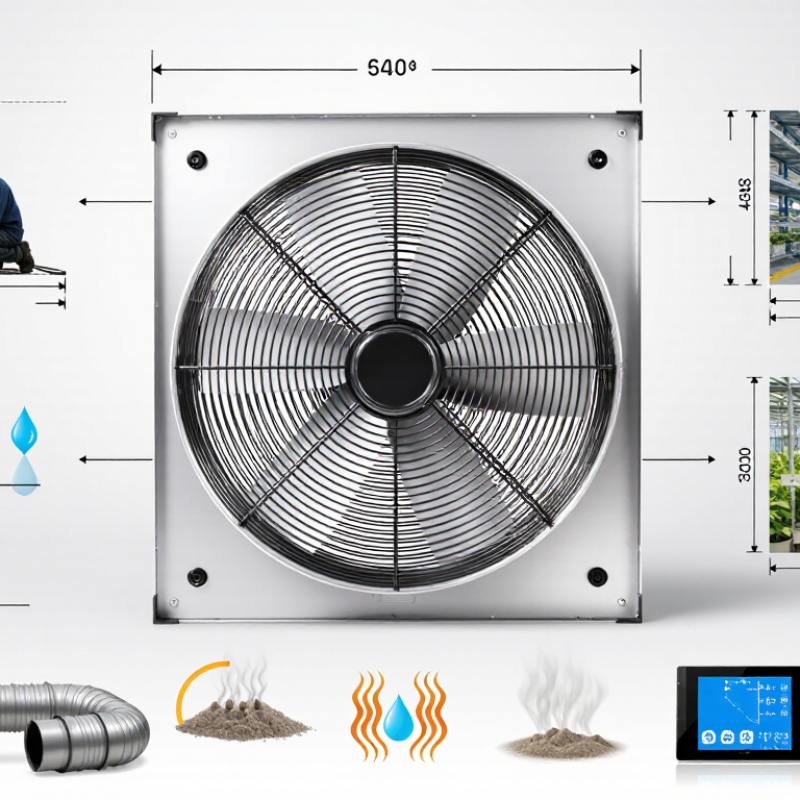
Before choosing an industrial ventilation fan in 2026, define what the space must remove. List dust, welding fume, solvent vapor, heat, moisture, and process odors. Measure where each contaminant starts, how often it appears, and who works nearby. Measure the source. A general air-change target cannot replace source capture.
The ACGIH Industrial Ventilation Manual, 31st edition, identifies capture velocity as a key design variable. Its guidance commonly places low-energy contaminant sources near 50–100 feet per minute. Moderate releases may require 100–200 feet per minute, while high-energy processes can need 200–500 feet per minute.
These values are starting points, not automatic specifications. Enclosures, hood distance, cross-drafts, and worker movement can change the result.
Check exposure limits before calculating fan airflow. OSHA permissible exposure limits and NIOSH recommended exposure limits provide useful benchmarks for hazardous substances. ASHRAE Standard 62.1-2022 supports ventilation planning for occupied spaces, but it does not replace process-exhaust design.
A practical assessment should record room volume, contaminant load, temperature, humidity, and replacement-air paths. Poorly planned makeup air can pull fumes across an operator’s breathing zone. That omission is costly.
I have also seen clean-looking layouts fail because doors, conveyors, or ceiling fans disturbed the hood’s airflow. Recheck the design under real operating conditions, including startup, cleaning, and peak production.
How to Choose an Industrial Ventilation Fan in 2026?
Industrial fan selection should begin with the application, not the motor size. Axial fans move large air volumes through open areas, tunnels, and warehouses. They usually suit low-pressure systems with short duct runs. Centrifugal fans create stronger pressure for long ducts, filters, and enclosed process lines. Mixed-flow fans offer a practical balance between airflow and pressure. They can fit compact ventilation systems with changing resistance.
The environment matters just as much. Dusty workshops may need abrasion-resistant impellers and easy-clean housings. Hot process air requires temperature-rated materials and carefully selected bearings. Corrosive vapors demand compatible construction, but assumptions can be costly. Measure airflow, static pressure, temperature, humidity, and operating hours before comparing models. A quiet fan is not always efficient. A powerful fan may create unnecessary energy use and noise. I have seen projects overestimate airflow while ignoring blocked filters. That mistake returns quickly.
Tips: Check the fan curve at the actual working point. Leave access for belt, bearing, and filter maintenance. Consider variable-speed control when demand changes during shifts. Confirm electrical data with a qualified engineer and follow applicable safety requirements. Record sound levels near occupied workstations. Recheck the design after installation, because real duct resistance often differs from drawings.
Compare industrial fan types by typical airflow capacity and common applications.
Axial fans are commonly selected for high airflow at low-to-moderate static pressure, while centrifugal fans are better suited to duct systems, filters, and higher-pressure applications. Mixed-flow fans provide a balance between airflow and pressure. Roof exhausters are typically used for general building ventilation, and portable air movers are suitable for localized cooling or temporary air circulation. The airflow ranges shown are indicative engineering ranges for common industrial equipment classes; final selection should also consider static pressure, temperature, corrosive conditions, noise, efficiency, and duty cycle.
How to Choose an Industrial Ventilation Fan in 2026?
Start with the airflow requirement, not the fan size. Measure the room’s length, width, and height, then multiply the volume by the required air changes per hour. For example, a 600 m³ workshop needing 10 air changes requires about 6,000 m³/h. Process emissions may require more airflow than general room ventilation. Capture velocity also matters near welding, dust, or heat sources. Use current engineering standards and site measurements when possible.
Static pressure is the resistance the fan must overcome. Add losses from filters, ducts, bends, grilles, dampers, and the discharge point. A long duct with several elbows can create surprisingly high resistance. Check the fan curve at the required airflow and total pressure. Do not select a fan using free-air performance. Include a modest allowance for filter loading, often 10–20%, but avoid excessive oversizing. It can increase noise, energy use, and unstable operation.
Tips: Record duct dimensions and fitting types. Ask for tested performance data. Inspect the filter when dirty, not only when new. A field estimate can be wrong. Recheck it. Temperature, dust, and altitude can also change fan performance. Leave access for cleaning and pressure measurement, because real systems rarely behave exactly like drawings.
| Application | Room Volume | Illustrative Air Changes per Hour | Calculated Airflow | Example Static-Pressure Allowance | Preliminary Fan Duty Point |
|---|---|---|---|---|---|
| General workshop | 600 m³ | 8 ACH | 4,800 m³/h ≈ 2,825 CFM | 350 Pa ≈ 1.40 in. w.g. | 4,800 m³/h at 350 Pa |
| Welding work area | 900 m³ | 10 ACH | 9,000 m³/h ≈ 5,297 CFM | 500 Pa ≈ 2.01 in. w.g. | 9,000 m³/h at 500 Pa |
| Warehouse ventilation | 5,000 m³ | 4 ACH | 20,000 m³/h ≈ 11,772 CFM | 250 Pa ≈ 1.00 in. w.g. | 20,000 m³/h at 250 Pa |
| Machine room | 300 m³ | 12 ACH | 3,600 m³/h ≈ 2,119 CFM | 400 Pa ≈ 1.61 in. w.g. | 3,600 m³/h at 400 Pa |
| Commercial kitchen exhaust system | 250 m³ | 20 ACH | 5,000 m³/h ≈ 2,943 CFM | 600 Pa ≈ 2.41 in. w.g. | 5,000 m³/h at 600 Pa |
Calculation guide: Required airflow (m³/h) = room volume (m³) × air changes per hour (ACH). CFM ≈ m³/h × 0.5886. Static pressure is the sum of the pressure losses through the actual ductwork, fittings, hoods or grilles, and filters; the example values above are illustrative, not universal design values. Select a fan that delivers the required airflow at the calculated system static pressure, using its performance curve. ACH is a preliminary planning method and may not account for contaminant capture, heat loads, process requirements, or local regulations. Provide suitable make-up air and verify the final design with a qualified ventilation professional.
Energy efficiency should begin with real operating conditions, not brochure figures. Measure airflow, static pressure, running hours, and seasonal temperature changes. A high-efficiency motor can reduce electricity use, but poor duct design may erase those savings. Variable-speed control helps match ventilation to occupancy, heat, dust, or humidity. Select sensors that respond reliably, and confirm that the control system supports safe manual override. In practice, operators sometimes set fans too high because “more air” feels safer. That choice can waste energy and increase noise.
Tips: Check measured airflow. Compare motor efficiency. Inspect control response. Ask for test data. Keep records.
Material selection also deserves careful attention. Galvanized steel may suit dry general ventilation, while stainless steel can better resist moisture and corrosive contaminants. Coatings are useful, but damaged surfaces need prompt inspection. Check impeller balance, bearing access, guard strength, and cleaning space before purchase. A fan that performs well on day one may become inefficient when dust builds up. I have seen maintenance access treated as an afterthought. That mistake is expensive.
Choose controls that maintenance staff can understand without constant specialist support. Review alarms, remote monitoring, emergency shutdowns, and power-failure behavior. Verify performance under actual pressure, not only free-air conditions. The best selection is rarely the largest fan. It is the one that delivers stable airflow with measurable energy use and manageable maintenance.
Selecting an industrial ventilation fan starts with the standards governing your facility. Check local mechanical, electrical, fire, and workplace ventilation requirements before comparing airflow ratings. A fan must deliver the required volume after duct resistance, bends, filters, and dampers reduce performance. Do not trust the catalogue airflow alone. I have seen an apparently powerful fan struggle because the duct layout was treated as an afterthought. Confirm static pressure, operating temperature, noise limits, and the area’s environmental conditions. If vapors, dust, or moisture are present, obtain a qualified assessment before selecting equipment.
Tips: Measure the room, duct length, outlet size, and heat load. Keep these records.
Installation requirements deserve equal attention. Provide strong supports, vibration isolation, safe access, and correctly sized electrical protection. Maintain clearance around the intake and discharge. Poorly positioned outlets can return contaminated air through nearby openings. Include inspection doors where possible. They save time later. Maintenance should be planned before commissioning. Check guards, belts, bearings, fasteners, filters, and corrosion points at scheduled intervals. Record airflow, vibration, temperature, and unusual sounds. Small changes often reveal developing faults. My first maintenance plan was too optimistic; real dust levels required shorter filter intervals. Review the schedule after the first month, then adjust it using actual readings and technician feedback.

Sign up for our mailing list to stay informed and up to date with our latest news and products!
(905) 832 – 0600
2175-A Teston Road
Maple, Ontario
L6A 1T3
(780) 451 – 0238
24790 – 117 Avenue
Acheson, Alberta
T7X 6C2
(604) 882 – 1564
9511 – 194A Street
Surrey, British Columbia
V4N 4G4
(306) 955 – 6005
3926 Arthur Rose Avenue Saskatoon, Saskatchewan
S7P 0C9
(450) 687 – 2721
2750 Rue Bernard-Lefebvre
Laval, Quebec
H7C 0A5