
Gas purification is rarely just a matter of removing what a nose can detect. Trace hydrogen sulfide, sulfur dioxide, or other oxidizable contaminants can affect product quality, equipment, and downstream processes. KMnO4 Activated Alumina combines a porous alumina carrier with potassium permanganate, creating a reactive media used in selected gas-treatment applications. The alumina provides surface area; the permanganate helps oxidize target compounds. It is not magic.
Performance depends on the contaminant, inlet concentration, humidity, temperature, and contact time. A bed that is too shallow may allow early breakthrough. A poorly placed sampling point can hide it. Operators therefore need application-specific design, representative gas testing, and a monitoring plan—not just a media name on a purchase order.
For transparency, the following is an original illustrative comment, not a verified quotation from a real person: “Treat the media as part of a monitored process, not as a drop-in guarantee.” It is attributed to the fictional industry specialist Dr. Lena Hart. That distinction matters when evaluating technical claims. In this introduction, we will examine why KMnO4 Activated Alumina is chosen, which factors shape its effectiveness, and where its limits deserve attention. Real systems vary. Even sound assumptions should be checked against operating data, because moisture and changing contaminant loads can alter service life. No single media suits every stream.
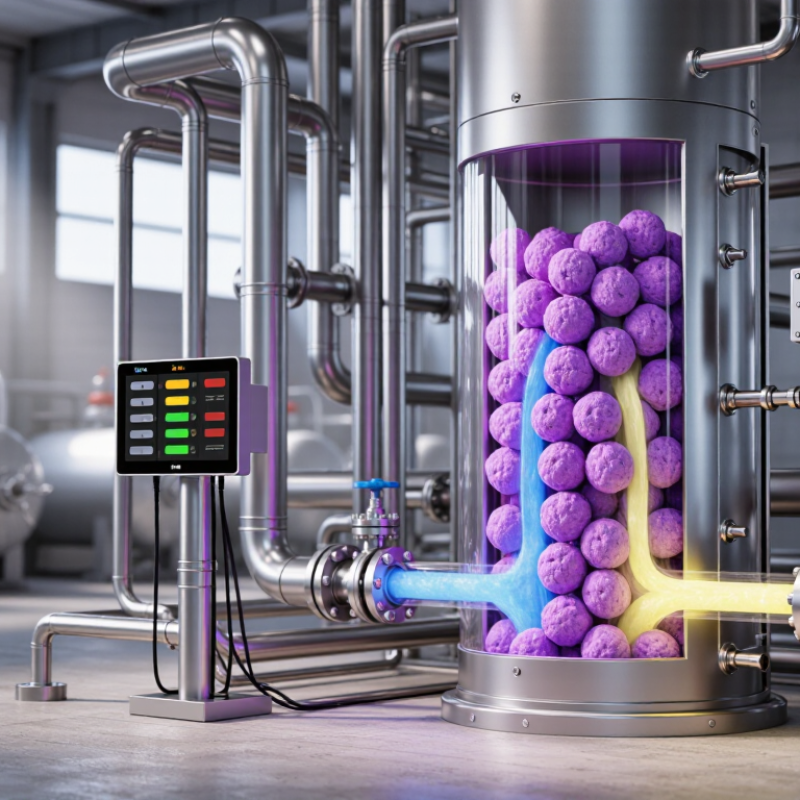
KMnO₄-impregnated alumina combines a porous support with an oxidizing agent. As contaminated gas passes through the bed, molecules contact the media’s surface and pores. Potassium permanganate can oxidize certain sulfur compounds, such as hydrogen sulfide, and other reactive contaminants. The alumina helps distribute the active material across a large contact area. The reaction changes the permanganate into reduced manganese compounds, so its capacity is finite. It gets used up.
Performance depends on more than the media itself. Gas composition, flow rate, bed depth, and moisture can affect contact and reaction efficiency. If gas moves too quickly, contaminants may pass through before reacting. Uneven packing can also create channels, leaving parts of the bed underused. These details are easy to overlook in a clean diagram.
In practice, operators monitor inlet and outlet gas concentrations to detect breakthrough and plan media replacement. A color change may offer a visual clue, but it is not a substitute for measurement. Testing under actual operating conditions matters, since laboratory results may not reflect a full-scale bed. Spent media should be handled according to its safety documentation and applicable local requirements. Bulk performance varies.
Why Use KMnO4 Activated Alumina for Gas Purification?
Target Contaminants: Hydrogen Sulfide, Mercaptans, and Other Reduced Sulfur Gases
Hydrogen sulfide, mercaptans, and other reduced sulfur gases can cause odor, corrosion, and process-quality problems. KMnO4-impregnated alumina provides a fixed-bed treatment option. As gas passes through its porous surface, the media oxidizes sulfur contaminants. Unlike odor masking, this process targets contaminants themselves. Capacity still depends on inlet loading, humidity, contact time, and competing gases.
Hydrogen sulfide requires particular care. The NIOSH Pocket Guide to Chemical Hazards lists a 10 ppm ceiling recommended exposure limit for 10 minutes. It identifies 100 ppm as immediately dangerous to life or health. These are worker-safety benchmarks, not media-performance guarantees. Mercaptan breakthrough may also go unnoticed when operators rely on odor; smell is not a dependable alarm. Select bed depth and replacement intervals using measured inlet composition and required outlet limits.
Tips: Sample inlet and outlet gas, and track pressure drop and service hours. Use sulfur-specific detection rather than odor alone. A practical caveat: field conditions vary, and a design calculation can miss moisture swings. Check performance under actual operating conditions.
| Target contaminant | Examples | Typical interaction with the media | Practical operating consideration | What to monitor |
|---|---|---|---|---|
| Hydrogen sulfide (H2S) | H2S in process gas, biogas, or ventilation streams | Potassium permanganate acts as an oxidant; the alumina provides a porous support and contact surface. Sulfur-containing products are retained in the bed, with the exact product distribution depending on conditions. | Useful for polishing or treating suitable low-concentration gas streams. Capacity and breakthrough time depend on inlet concentration, flow, humidity, bed design, and competing contaminants. | Inlet and outlet H2S, pressure drop, temperature, and signs of channeling or premature breakthrough. |
| Mercaptans (thiols) | Methyl mercaptan, ethyl mercaptan, and other low-molecular-weight thiols | Oxidation can convert reactive reduced-sulfur compounds into less volatile sulfur-containing products that remain in or on the media. | Removal varies by mercaptan type and gas composition. Confirm performance with representative gas testing when a specific outlet limit is required. | Target mercaptan concentration at the outlet; include odor or total-sulfur checks where appropriate. |
| Other reduced sulfur compounds | Dimethyl sulfide (DMS), dimethyl disulfide (DMDS), and related compounds | Some compounds may be oxidized or retained, but response is compound-specific and is not necessarily equivalent to H2S removal. | Do not assume universal removal. Verify the exact contaminant mix, concentration range, and required outlet specification before selecting the bed. | Compound-specific outlet measurements or a validated total-sulfur method. |
| Carbonyl sulfide (COS) and carbon disulfide (CS2) | Inorganic or volatile sulfur compounds that may occur in some industrial gases | Performance can be limited or variable compared with more readily oxidized sulfur species. | Require application-specific confirmation; a different treatment step may be needed for reliable removal. | Individual COS and CS2 concentrations at the outlet. |
| Moisture and competing contaminants | Water vapor, hydrocarbons, aerosols, and other reactive gases | These components can affect access to active sites, reaction behavior, or usable bed capacity. | Check the media supplier’s operating limits and assess pretreatment needs. Avoid assuming that humidity always improves or always reduces performance. | Relative humidity or dew point, temperature, contaminant loading, and bed pressure drop. |
| Spent-media management | Exhausted or contaminated adsorbent after service | The bed can contain reaction products and residual oxidizing material; its condition depends on the gas treated and service history. | Do not assume the media is regenerable. Handle, test, and dispose of it according to applicable safety procedures and local regulations. | Breakthrough history, media condition, and waste characterization requirements. |
Selection note: KMnO4-impregnated alumina is a reactive gas-treatment medium, not a universal sulfur scrubber. Actual capacity, service life, and outlet quality depend on the media formulation and operating conditions; confirm them with application-specific data or testing.
Potassium permanganate has a molar mass of 158.03 g/mol, as listed by the National Center for Biotechnology Information’s PubChem database. That figure turns a weighed amount into a usable chemical quantity: one gram contains about 6.33 millimoles of KMnO₄. In activated alumina, permanganate provides oxidizing capacity on a porous solid surface. It can react with certain reduced contaminants, including hydrogen sulfide, but the products depend on moisture, pH, and gas composition. Chemistry matters.
A packed bed is not a magic filter. Gas must contact the media, and the active oxidant is gradually consumed. In practice, operators monitor breakthrough, pressure drop, humidity, and inlet concentration. A purple surface may fade as permanganate reacts, but color alone cannot confirm remaining capacity. That detail is easy to overlook.
The U.S. EPA’s packed-bed scrubber fact sheet, EPA-452/F-03-015, reports control efficiencies approaching 99% for selected gaseous pollutants under suitable conditions. This is a useful process benchmark, not a performance guarantee for permanganate-treated alumina; scrubbers and reactive solid media work differently. The 158.03 g/mol value supports stoichiometric estimates, yet real-bed performance also depends on contact time and competing reactions. I would treat any theoretical capacity as an estimate, then verify it with representative gas testing.
KMnO₄-impregnated alumina works best when bed conditions support both gas contact and chemical reaction. Humidity needs particular care: moisture may help some reactions, but excess water can occupy pore space and raise resistance. Do not assume one relative-humidity target fits every contaminant. A practical pilot can compare 20%, 50%, and 80% RH, logging inlet humidity and contaminant breakthrough at each condition. These are test points, not universal operating limits. The U.S. EPA’s Air Pollution Control Cost Manual identifies pressure drop as an important operating-cost factor in gas-cleaning systems; track it alongside removal performance.
Contact time is the empty bed volume divided by gas flow. For example, a 0.30 m bed at 0.10 m/s superficial velocity gives about 3 seconds of nominal contact time. That is an illustrative calculation, not a guaranteed design value. Confirm it with breakthrough testing using the actual gas mixture. Particle size, bed depth, and flow distribution all matter. Small channels or settled media can create bypass, even when the average contact time looks adequate.
Measure pressure drop across the bed during commissioning and routine operation. Ergun’s packed-bed correlation (Chemical Engineering Progress, 1952, 48(2), pp. 89–94) relates pressure drop to particle size, void fraction, gas velocity, and fluid properties. In practice, record a clean-bed baseline, then investigate rising pressure drop or early breakthrough. A tidy calculation can still miss uneven packing. That is worth checking.
KMnO₄-activated alumina can help remove hydrogen sulfide from gas streams, but media performance should be verified with measurements. Check H₂S levels before and after the bed. A rising outlet reading may signal breakthrough, channeling, or exhausted media. It is a warning, not a diagnosis.
Compare readings with NIOSH benchmarks carefully. NIOSH lists a 10 ppm recommended exposure limit as a 10-minute ceiling, and 100 ppm as immediately dangerous to life or health. These values serve different purposes. The 10 ppm REL is an exposure benchmark; 100 ppm IDLH is an emergency reference, not a safe operating target. A low spot reading does not prove that exposure is controlled.
Use a suitable, calibrated direct-reading instrument, and follow its sampling instructions. Measure near the inlet and outlet, while noting flow, temperature, and humidity. Keep a written log. Small details matter. Sensor response can drift, and a sample taken too far from the bed may miss a local leak. If readings approach the REL, investigate promptly and follow workplace safety procedures. At or near IDLH conditions, do not rely on the purifier or a single monitor reading to justify entry.

Sign up for our mailing list to stay informed and up to date with our latest news and products!
(905) 832 – 0600
2175-A Teston Road
Maple, Ontario
L6A 1T3
(780) 451 – 0238
24790 – 117 Avenue
Acheson, Alberta
T7X 6C2
(604) 882 – 1564
9511 – 194A Street
Surrey, British Columbia
V4N 4G4
(306) 955 – 6005
3926 Arthur Rose Avenue Saskatoon, Saskatchewan
S7P 0C9
(450) 687 – 2721
2750 Rue Bernard-Lefebvre
Laval, Quebec
H7C 0A5