
Choosing a pick and place machine is not just a question of speed. The right Place Machine must match your products, board sizes, component mix, and production goals. A line assembling compact control boards has different needs from one handling large connectors or frequent product changes.
Start with the work the machine will perform each day. Consider placement accuracy, feeder capacity, nozzle options, supported component sizes, and the time needed for changeovers. Ask suppliers to explain how quoted throughput was measured; published figures may not reflect your actual board layout or component mix. If possible, test representative boards and review placement results before making a decision. Small details matter. A feeder that is awkward to load can slow operators repeatedly, while a software interface that is hard to learn may complicate routine setup.
Budget for more than the purchase price. Installation, training, maintenance, spare parts, and software support affect the machine’s long-term value. Check what service response is available and whether your team can perform routine upkeep. A perfect specification sheet can still mislead. Real production is messier. One overlooked component or changeover requirement can alter the economics.
The following ten tips offer a practical framework for comparing machines and suppliers. They focus on measurable requirements, realistic demonstrations, and support after delivery. Use them to prepare better questions, not as a substitute for checking your own production data. The best choice is the one your team can operate reliably as needs change.
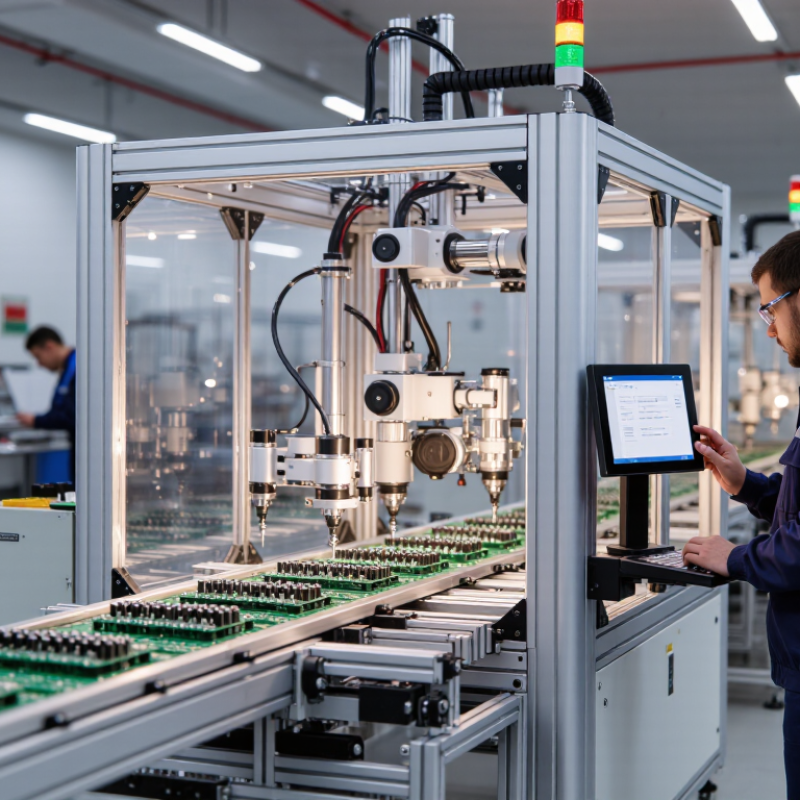
A pick and place machine should match the work you actually run, not an optimistic forecast. Record boards per shift, shifts per week, product changes, and peak demand. Small batches change everything. A line built for high volume may spend too much time waiting during frequent feeder changes. The International Federation of Robotics reported 4.28 million industrial robots operating worldwide in 2023, a 10% increase from 2022. That broader trend supports evaluating automation, but it does not prove that a faster machine will pay off in your factory. Compare usable placement capacity with real product mix, changeover time, staffing, and planned downtime. A spreadsheet forecast is never the whole story.
Check board dimensions against the machine’s usable working area, including panels, rails, and clearance for fixtures. A large board can reduce the available placement zone, so confirm the actual panel size with a sample or drawing. Then set manufacturing goals: shorter lead times, fewer placement errors, easier product changeovers, or room for future growth. Deloitte and The Manufacturing Institute’s 2024 smart-manufacturing survey found 86% of surveyed executives expected smart manufacturing to be a primary competitiveness driver within five years. Treat that as strategic context, not a machine-performance promise. Write down the target cycle time and acceptable changeover window. The right specification may be less impressive on paper, but better suited to Monday’s mixed production schedule.
The chart shows illustrative rated-capacity targets for different daily production volumes, assuming 500 placements per board, an 8-hour shift, and a 25% capacity allowance. These are planning estimates, not guaranteed machine outputs. Actual throughput depends on component mix, board size, changeovers, and process requirements; confirm the machine’s working area and real-world performance with your production data.
A pick and place machine should match the components you actually build with, not just the smallest parts listed in a specification sheet. Check the full range: tiny chip components, fine-pitch packages, connectors, and any unusually tall or heavy parts. Small parts vary. A nozzle that handles a miniature resistor may not grip a large connector securely, while a package that exceeds the machine’s placement height can cause collisions or missed placements.
Review feeder capacity alongside component size. A machine may support many feeder positions, but bulky reels can take up more space than narrow tapes. Confirm that the required feeders, nozzles, and placement heads can work together in your planned setup. Ask for a demonstration using representative parts and boards, especially if you use fine-pitch components or mixed package sizes. Watch for stable pickup and accurate placement, not only the headline speed. That matters.
Production plans change. Leave reasonable room for new package types, but avoid paying for capacity your line will rarely use. I’ve seen equipment choices look right on paper, then require awkward feeder changes during a real changeover. That is not always a machine problem; sometimes the estimate was too optimistic. Compare your current component inventory with likely upcoming jobs, and verify limits with the supplier before committing.
Placement accuracy should match the smallest, most demanding component on your board. A machine’s advertised accuracy is only part of the picture. Ask how it performs with fine-pitch parts, uneven boards, and components placed near panel edges. That matters. In a trial, inspect several boards under normal production conditions, not just one carefully prepared sample. Look for shifted parts and repeatable placement, then check how the machine handles corrections.
Speed figures can be misleading. Compare actual output using your board layout, component mix, and changeover routine. A fast placement head may lose time waiting for parts or switching nozzles. I would not chase the highest cycle rate alone; it may look efficient on paper but stall beside a slow feeder. Real boards reveal more.
Feeder compatibility affects both setup time and supply flexibility. Confirm the machine supports the feeder types and tape widths your components require. Check how quickly operators can load, identify, and replace feeders without disturbing nearby positions. One detail is easy to miss: feeder capacity may shrink when bulky parts crowd the setup. Ask for a changeover demonstration using a representative job, and note any manual steps. A small mismatch can mean extra preparation time every shift.
| # | Selection tip | What to compare | Practical evaluation |
|---|---|---|---|
| 1 | Verify placement accuracy | Specified placement accuracy and repeatability, including the measurement conditions and component types used. | Ask for a placement demonstration using representative parts and inspect results against the board and component tolerances. Published figures may use different test methods, so compare like with like. |
| 2 | Assess real production speed | Rated placements per hour (CPH) versus expected output with your actual mix of components, feeders, and board changes. | Treat headline CPH as a reference, not a guaranteed line rate. Request a timed trial or a realistic estimate that includes pickup, vision, travel, and setup time. |
| 3 | Check feeder compatibility | Supported tape widths, feeder types, feeder quantities, and whether feeders are shared across machines or lines. | Match the feeder plan to your bill of materials. Common tape widths include 8, 12, 16, 24, and wider formats; confirm the machine supports the specific feeders your parts require. |
| 4 | Confirm component coverage | Supported component size, height, mass, package style, and pickup method, including nozzles and vision options. | Check the full component list, especially fine-pitch parts, odd-form components, and tall or heavy packages. Confirm any required tooling or process limits in writing. |
| 5 | Match the board work area | Maximum and minimum board dimensions, board thickness, support method, and panel handling requirements. | Compare machine limits with both current and planned boards. Include panel rails, unusual shapes, double-sided processing, and any required support pins or fixtures. |
| 6 | Evaluate changeover time | Offline job preparation, feeder setup, nozzle changes, program loading, and verification between products. | Ask how much work can be prepared while the machine is running. For high-mix production, compare changeover time using a representative product change rather than a theoretical estimate. |
| 7 | Review vision and inspection features | Fiducial recognition, component alignment, polarity checks, barcode support, and available inspection or traceability functions. | Confirm that the vision system can recognize your board fiducials and package types under production conditions, including expected lighting, surface finish, and component orientation. |
| 8 | Check software and line integration | Program import, data formats, production tracking, machine communication, and compatibility with upstream and downstream equipment. | Verify the required interfaces and data flow with your existing process. Confirm how programs, revisions, alarms, and production records are managed. |
| 9 | Estimate uptime and service needs | Preventive maintenance tasks, spare-part availability, service response arrangements, and operator training requirements. | Request a maintenance schedule and a recommended spare-parts list. Consider how quickly your team can receive support and resume production after a fault. |
| 10 | Compare total operating cost | Purchase and installation costs, feeders, nozzles, software, maintenance, utilities, training, and expected production capacity. | Compare the full cost over your planned ownership period, not just the machine price. Base the calculation on realistic throughput, staffing, changeovers, and support needs. |
Note: Actual placement accuracy, throughput, and feeder capacity depend on the machine configuration, components, board design, and production conditions. Confirm specifications and test results for your application before purchase.
A pick-and-place machine’s software should make routine work clear, not merely offer a long list of functions. Ask an operator to load a board file, assign components, and correct a placement error during a live demonstration. Watch how many screens and manual entries the task requires. Try it live. Clear alarms, readable feeder maps, and searchable component libraries can reduce avoidable setup mistakes. Still, a polished demonstration may hide awkward steps, so test a typical job from your own production mix.
Line integration deserves the same practical scrutiny. Check conveyor height and width, board transfer direction, and how the machine signals upstream and downstream equipment. Confirm that production data can be exchanged in a format your existing systems support. A supplier’s answer is useful, but a trial with your actual board and line settings is more convincing. Note any manual handoffs; they often become small daily delays.
Changeover flexibility matters when product runs are short or varied. Look for saved job recipes, accessible feeder setups, and clear checks for nozzle or component changes. Time a changeover with the people who will perform it, including verification before the first board runs. A quick setup is not helpful if it invites loading errors. Be honest about the trade-off: flexible equipment can still require careful planning, and no software removes every source of downtime.
Service support deserves the same scrutiny as placement speed. Ask who answers after installation, how quickly a technician can respond, and which parts are stocked locally. During a factory visit, inspect access to feeder units, nozzles, and filters; cramped layouts can turn routine maintenance into lost production time. Request a sample maintenance schedule and written labor rates, not just a warranty headline. Downtime gets expensive. Siemens’ 2024 True Cost of Downtime report estimates unplanned downtime costs the world’s 500 largest companies 11% of annual revenue. That figure is not a machine-specific forecast, but it shows why response time belongs in the purchase calculation.
Compare total ownership costs over several years. Include preventive maintenance, software updates, training, spare parts, and the production hours needed for service. A low quote can become costly if common wear parts take weeks to arrive. Ask for realistic service intervals using your expected shift pattern and component mix. Then check whether the supplier can provide remote diagnostics without replacing every control or software system.
Future expansion should be tested against your actual floor plan. Can the machine accept additional feeders, handle new board sizes, or connect with existing production tracking? Deloitte’s 2024 smart-manufacturing survey found 92% of executives viewed smart manufacturing as a competitiveness driver within three years. That supports planning for connectivity, but it does not prove every upgrade will pay back. Plan for change. Leave space for material carts and maintenance access, too; buyers sometimes overlook both.

Sign up for our mailing list to stay informed and up to date with our latest news and products!
(905) 832 – 0600
2175-A Teston Road
Maple, Ontario
L6A 1T3
(780) 451 – 0238
24790 – 117 Avenue
Acheson, Alberta
T7X 6C2
(604) 882 – 1564
9511 – 194A Street
Surrey, British Columbia
V4N 4G4
(306) 955 – 6005
3926 Arthur Rose Avenue Saskatoon, Saskatchewan
S7P 0C9
(450) 687 – 2721
2750 Rue Bernard-Lefebvre
Laval, Quebec
H7C 0A5