Open-Wound
Windings are insulated and then exposed for ventilation, usually with protective varnish or similar treatment. This design supports efficient heat dissipation but generally requires a clean, dry installation environment.

Choosing the right transformer affects safety, efficiency, noise, and long-term maintenance. A Dry-Type Transformer uses air or solid insulation instead of liquid cooling. This design suits hospitals, offices, factories, data centers, and renewable-energy facilities.
This guide examines ten important dry-type transformer categories, including cast resin, VPI, air-core, isolation, grounding, and distribution models. Each type has a different purpose. Cast resin units resist moisture in demanding indoor environments. VPI transformers offer reliable insulation for industrial equipment. Air-core designs can reduce magnetic losses in selected applications, although they are not ideal everywhere.
Details matter.
We will compare cooling methods, insulation systems, voltage ranges, installation conditions, and practical operating limits. Real-world selection depends on load size, harmonic content, altitude, enclosure protection, and available ventilation. A compact transformer beside a production line may face heat, dust, vibration, and constant switching. A hospital installation demands different priorities, including low noise and dependable isolation.
The categories can overlap, and no single list fits every manufacturer’s terminology. That is worth remembering. Technical datasheets may use similar names for different construction details. Therefore, this overview focuses on engineering function rather than labels alone. It also considers maintenance access, fire-safety expectations, efficiency, and lifecycle value. Readers can use these comparisons to ask better questions before purchasing or specifying a Dry-Type Transformer.
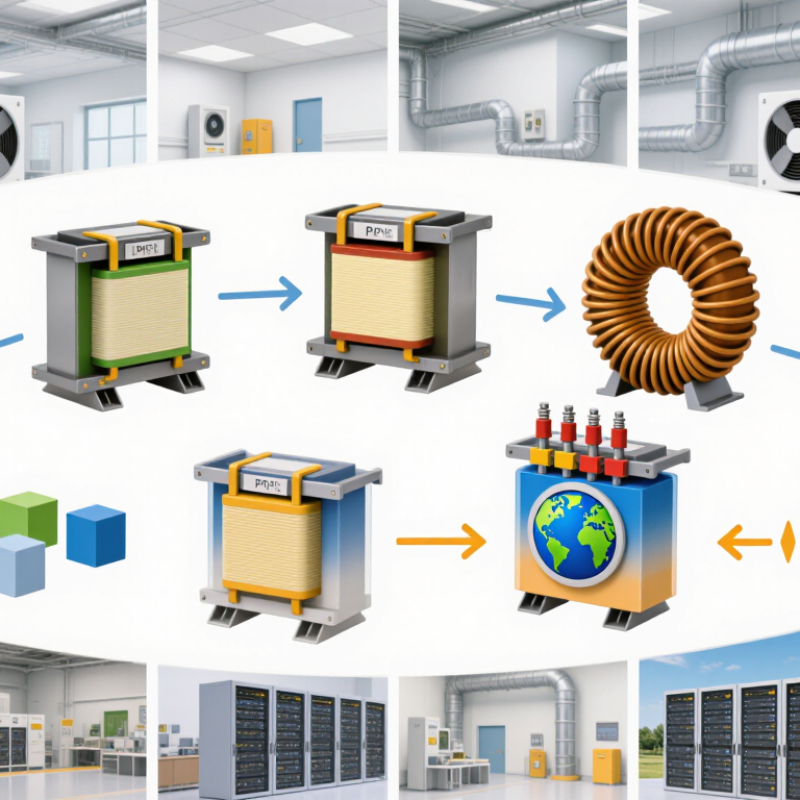
A practical list of ten dry-type transformer designs includes air-core, laminated iron-core, toroidal, ferrite-core, powdered-iron, nanocrystalline, amorphous-metal, C-core, E-I core, and gapped-core transformers. The best choice depends on frequency, power, insulation needs, and available space. A simple ranking can mislead. Design conditions matter more.
Air-core transformers use no magnetic core. They suit high-frequency circuits because they avoid core saturation and some hysteresis losses. Their magnetic coupling is weaker, however. Physical spacing becomes important. Even a few centimeters can affect performance.
Iron-core transformers remain common in low-frequency power systems. Laminated E-I and C-core structures reduce eddy-current losses. Engineers inspect insulation clearances, winding temperature, and audible vibration during testing.
Toroidal iron-core transformers use a continuous ring-shaped core. This geometry usually reduces leakage flux and produces a compact profile. It can also create high startup current, especially with unfavorable switching conditions.
Ferrite cores support higher-frequency operation and lighter assemblies. Powdered-iron cores provide useful distributed air gaps for energy storage.
Nanocrystalline and amorphous materials can reduce losses in specialized applications. Gapped cores help control inductance but may increase stray magnetic fields.
Real installations are less tidy than diagrams. A toroidal unit may fit perfectly, yet its mounting hardware can introduce noise. Measurements under load should guide the final selection.
Among the ten main types of dry type transformers, insulation design strongly affects safety, maintenance, and service life. Open-wound transformers use exposed coils treated with varnish. They offer good heat dissipation and easy visual inspection. However, dust, moisture, and chemical vapors can attack the insulation.
VPI, or vacuum pressure impregnated, transformers receive varnish under controlled vacuum and pressure. This process fills small air spaces around the windings. VPI units usually handle vibration and thermal cycling better than basic open-wound designs. Cast-resin transformers surround the windings with solid epoxy resin. They resist moisture and work well in dusty indoor rooms, tunnels, and high-humidity facilities. Their sealed construction needs less cleaning, but repairs can be difficult after serious winding damage. No type wins every site. That is worth remembering.
Tips: Check the environment before choosing insulation. Record humidity, dust levels, load patterns, and available ventilation. During inspection, look for cracked resin, darkened varnish, loose connections, and unusual noise. Keep clearances clean. A neglected filter can raise operating temperature quickly. Engineers should also compare short-circuit strength, noise limits, fire requirements, and maintenance access. Manufacturer data matters, but real site conditions matter more. Some selection decisions seem obvious and later prove incomplete. That is why thermal studies and commissioning tests should support the final choice.
Open-wound, VPI, and cast-resin transformers are commonly distinguished by how their windings are insulated and protected. The chart shows the maximum continuous temperature associated with internationally recognized insulation thermal classes.
Windings are insulated and then exposed for ventilation, usually with protective varnish or similar treatment. This design supports efficient heat dissipation but generally requires a clean, dry installation environment.
Vacuum pressure impregnation forces insulating resin into the winding structure. The process improves mechanical strength and helps reduce voids compared with simple varnish application.
Windings are encapsulated in solid resin, providing strong protection against moisture, dust, and many industrial contaminants. These transformers are often selected where environmental robustness is important.
Reference basis: thermal endurance limits from IEC 60085 insulation thermal classes. Actual transformer temperature rise, insulation class, and cooling performance depend on the specific design and applicable standards.
What Are the Top 10 Types of Dry Type Transformers?
Cooling and Enclosure Types: Ventilated, Non-Ventilated, and Sealed Transformers
Dry-type transformers are classified by insulation, winding construction, installation method, and cooling design. Common categories include cast-resin, vacuum-pressure-impregnated, open-wound, ventilated, non-ventilated, and sealed units. Cooling and enclosure choices strongly affect reliability, maintenance, and installation cost.
Ventilated transformers use air openings to remove heat from the core and windings. They suit clean, dry electrical rooms with controlled airflow. However, dust, moisture, and chemical vapors can enter through the enclosure. Regular inspection is essential. A blocked grille may raise winding temperature surprisingly fast. Non-ventilated transformers provide a more enclosed structure, reducing exposure to airborne contaminants. Their heat dissipation is usually more limited, so engineers must check loading and clearance carefully.
Sealed transformers isolate internal components from the surrounding atmosphere. They work well in damp, dusty, or corrosive locations when correctly specified. Some designs use sealed air, nitrogen, or resin protection. The enclosure must still release heat safely. That detail is easy to overlook. In practice, selecting among these three types requires more than comparing ratings. Engineers should review ambient temperature, altitude, indoor airflow, enclosure rating, noise limits, and expected load cycles. Field conditions often differ from drawings. A clean room can become dusty after nearby construction. That possibility deserves attention before installation.
| No. | Transformer Type | Cooling and Enclosure Classification | Construction | Typical Capacity Range | Typical Installation | Main Advantages and Considerations |
|---|---|---|---|---|---|---|
| 1 | Ventilated Dry-Type Transformer | AN Ventilated Natural air circulation through ventilation openings | Windings and core are exposed to clean cooling air, normally protected by a ventilated enclosure. | Approximately 15 kVA to 5,000 kVA, depending on voltage and design. | Commercial buildings, industrial plants, utility rooms, and indoor electrical rooms. | Simple, economical, and easy to inspect. Requires a clean, dry, well-ventilated environment. |
| 2 | Non-Ventilated Dry-Type Transformer | AN Non-ventilated Heat is transferred through a closed enclosure | Active parts are enclosed without air openings; the enclosure dissipates heat to the surrounding air. | Commonly used for small and medium ratings, often up to several hundred kVA. | Locations where dust, fibers, or accidental contact must be minimized. | Provides improved protection against contaminants. Heat dissipation is lower than in a comparable ventilated design. |
| 3 | Sealed Dry-Type Transformer | AN Sealed Hermetically or gasket-sealed enclosure | Windings and core are isolated from the external atmosphere inside a sealed enclosure. | Typically selected for low and medium power distribution duties. | Humid, dusty, corrosive, or contaminated indoor and outdoor environments. | Reduces moisture and contaminant ingress. The enclosure must be designed to manage internal heat and pressure changes. |
| 4 | Forced-Air Dry-Type Transformer | AF Ventilated Fan-assisted air cooling | Fans move air across the core and windings to increase heat removal. | Often used to increase the available rating of an AN-rated transformer; the actual rating is design-specific. | High-load industrial systems, data centers, and locations with changing load profiles. | Provides higher short-term or continuous capacity when permitted by the design. Fans add noise, controls, and maintenance requirements. |
| 5 | AN/AF Dual-Rated Transformer | AN/AF Ventilated Natural and forced-air modes | Designed to operate with natural cooling and with auxiliary fans switched on when additional capacity is required. | Typical in medium-voltage distribution applications where load demand varies. | Industrial facilities, hospitals, commercial complexes, and critical power systems. | Combines efficient low-load operation with increased capacity during peak demand. Fan controls and airflow clearance are important. |
| 6 | Cast-Resin Transformer | AN Non-ventilated or ventilated enclosure Air-cooled solid insulation | High-voltage windings are encapsulated in cured epoxy resin; the core and low-voltage winding remain air-cooled. | Commonly manufactured from approximately 100 kVA to several MVA. | Indoor substations, tunnels, marine facilities, renewable-energy plants, and high-humidity locations. | Good resistance to moisture, fire propagation, and contamination. Cast resin can make repairs and transportation more demanding. |
| 7 | Vacuum Pressure Impregnated Transformer | AN AN/AF Usually ventilated or protected by an enclosure | Coils are insulated with resin varnish or similar material applied through a vacuum-pressure impregnation process. | Frequently used from several hundred kVA to multi-MVA ratings. | Industrial plants, traction systems, power-generation auxiliaries, and demanding indoor installations. | Strong mechanical integrity and good thermal performance. Environmental sealing depends on the enclosure rather than the impregnation alone. |
| 8 | Open-Wound Dry-Type Transformer | AN Ventilated Open coil construction | Coils are wound and treated with insulating varnish, with air circulating directly around the windings. | Commonly used for low-voltage and small-to-medium distribution ratings. | Clean indoor electrical rooms, control panels, lighting systems, and general-purpose facilities. | Cost-effective and lightweight. It offers less protection from dust, moisture, and corrosive atmospheres than encapsulated designs. |
| 9 | Encapsulated Dry-Type Transformer | AN Non-ventilated or sealed Resin- or compound-encapsulated windings | Windings are enclosed in a solid insulating compound, which limits direct exposure to air and contaminants. | Typically applied to control, isolation, and small-to-medium distribution transformers. | Process equipment, outdoor control cabinets, marine applications, and polluted environments. | Improved protection from moisture, dust, and vibration. Encapsulation can reduce repairability and increase thermal mass. |
| 10 | Pad-Mounted Dry-Type Transformer | AN Outdoor enclosed Weather-resistant cabinet | A dry-type transformer installed in a lockable, weather-resistant ground-level enclosure. | Commonly specified from tens of kVA to approximately 2,500 kVA, subject to the manufacturer’s design. | Outdoor commercial sites, renewable-energy installations, campuses, and industrial distribution networks. | Improves personnel safety and site integration without using liquid insulation. Requires adequate outdoor clearances and thermal design. |
Isolation, autotransformer, and grounding transformers solve different power-quality problems. Choosing by voltage ratio alone is risky. Field experience shows that load behavior, fault exposure, and maintenance access often determine the correct design.
An isolation transformer separates primary and secondary circuits through two independent windings. It helps reduce common-mode noise and limits fault transfer, making it useful in medical rooms, control panels, and sensitive laboratory equipment. Shielding can improve performance, but it cannot replace correct grounding. The U.S. Department of Energy estimates its 2024 distribution-transformer rule could save 3.6 quadrillion Btu over 30 years. Efficiency still matters, even for specialized units.
Autotransformers use one shared winding, reducing copper, size, and cost. They suit voltage adjustment where electrical isolation is unnecessary. That limitation is easy to overlook.
Grounding transformers create a neutral point for systems without one, supporting earth-fault detection and controlled zero-sequence current. They are common in industrial medium-voltage networks and renewable-energy installations. IEC and IEEE guidance require careful coordination with protection relays and grounding impedance.
The choice is not always obvious. Engineers should compare inrush current, harmonic heating, enclosure ventilation, and prospective fault current. IEA’s Electricity 2024 report projects strong global electricity-demand growth through 2026, increasing pressure on reliable distribution equipment. A smaller transformer may look efficient on paper, yet poor ventilation can shorten insulation life. Site measurements and a documented protection study remain essential.
Common designs include air-core, iron-core, toroidal, ferrite-core, and powdered-iron transformers. Other options include nanocrystalline, amorphous-metal, C-core, E-I core, and gapped-core designs. The best choice depends on frequency, power, insulation, and available space.
Air-core transformers suit high-frequency circuits because they avoid core saturation. They can also reduce some hysteresis losses. Their magnetic coupling is weaker. Spacing matters greatly.
Toroidal transformers use a continuous ring-shaped core. They usually provide compact construction and reduced leakage flux. However, they may create high startup current during unfavorable switching conditions. Mounting hardware can also introduce unexpected noise.
Open-wound transformers use varnish-treated coils and dissipate heat effectively. Dust, moisture, and chemical vapors can damage their insulation. VPI designs fill winding air spaces with varnish under controlled pressure. Cast-resin designs surround windings with solid resin and resist moisture well.
Cast-resin or sealed designs often suit dusty, damp, or humid environments. Their enclosed construction reduces exposure to airborne contaminants. Serious winding damage may be difficult to repair. That trade-off matters.
Ventilated transformers use air openings to remove heat from internal components. They work best in clean, dry rooms with controlled airflow. Non-ventilated designs limit contamination but usually dissipate less heat. Loading and clearance require careful checking.
Review ambient temperature, altitude, humidity, dust, airflow, load cycles, and enclosure needs. Also compare insulation clearances, noise limits, short-circuit strength, and maintenance access. A nearby construction project may make a clean room dusty. Drawings are not always reality.
Inspect cracked resin, darkened varnish, loose connections, blocked grilles, and unusual noise. Measure temperature under load, not only during idle operation. Keep ventilation paths and clearances clean. I might overlook filters too, so inspections should be recorded.


Sign up for our mailing list to stay informed and up to date with our latest news and products!
(905) 832 – 0600
2175-A Teston Road
Maple, Ontario
L6A 1T3
(780) 451 – 0238
24790 – 117 Avenue
Acheson, Alberta
T7X 6C2
(604) 882 – 1564
9511 – 194A Street
Surrey, British Columbia
V4N 4G4
(306) 955 – 6005
3926 Arthur Rose Avenue Saskatoon, Saskatchewan
S7P 0C9
(450) 687 – 2721
2750 Rue Bernard-Lefebvre
Laval, Quebec
H7C 0A5