China Top Rain Umbrella Manufacturers for Global Buyers is a practical guide for importers seeking dependable suppliers and consistent product quality. China’s umbrella industry serves retailers, promotional brands, outdoor stores, and hospitality businesses worldwide. Experienced manufacturers can produce compact folding umbrellas, straight umbrellas, golf umbrellas, children’s styles, and automatic opening models. Their capabilities often include fabric selection, frame engineering, handle design, printing, packaging, and final inspection.
Rain Umbrellas may look simple, yet small details affect customer satisfaction. A weak shaft can bend in strong wind. Poor stitching may allow water through the canopy. Buyers should review fabric density, frame materials, opening performance, and corrosion resistance. Factory experience matters, but documented testing matters more. Ask for samples before approving large orders. Check production photos, inspection records, export experience, and communication speed. Clear specifications reduce misunderstandings about size, color, logo placement, packaging, and delivery schedules.
Reliable manufacturers should explain their quality controls honestly. They should also identify limitations instead of promising perfection. Some factories offer low prices but limited customization. Others provide stronger frames but require higher minimum quantities. This trade-off deserves careful review. Independent inspections can add confidence, especially for first-time buyers. However, inspections cannot replace clear contracts and realistic expectations. Weather conditions also vary by market, so one umbrella design may not suit every region. Careful sourcing, practical testing, and regular supplier communication help global buyers build safer and more stable purchasing programs. Mistakes can still happen. The goal is to reduce them.
China remains a major production base for rain umbrellas, supported by dense supplier networks and mature export infrastructure. ITC Trade Map, based on UN Comtrade records, identifies China as the leading exporter under HS 6601, covering umbrellas and similar products. This position reflects scale, not automatic quality.
Manufacturing clusters commonly combine fabric cutting, frame assembly, printing, stitching, and final inspection. Buyers can therefore source compact, golf, transparent, and automatic umbrellas within one supply region. Fortune Business Insights valued the global umbrella market at about US$7.22 billion in 2023. Its report forecasts continued growth through 2032, although demand varies sharply by climate and season.
Production is efficient. It is not flawless. Material consistency may change between batches, especially in low-cost orders. A practical audit should check rib strength, opening cycles, water resistance, seam finishing, and carton protection. The ISO 811 standard offers a useful reference for testing textile water penetration, but it does not replace buyer-specific inspection.
Factories with documented process controls usually provide more reliable results. Buyers should request pre-production samples and retain approved specifications. This simple step prevents many disputes.
Sustainability also needs closer attention, since recycled fabric claims require traceable evidence. Reported capacity can look impressive, yet actual peak-season capacity may be smaller. That gap deserves careful verification before placing large orders.
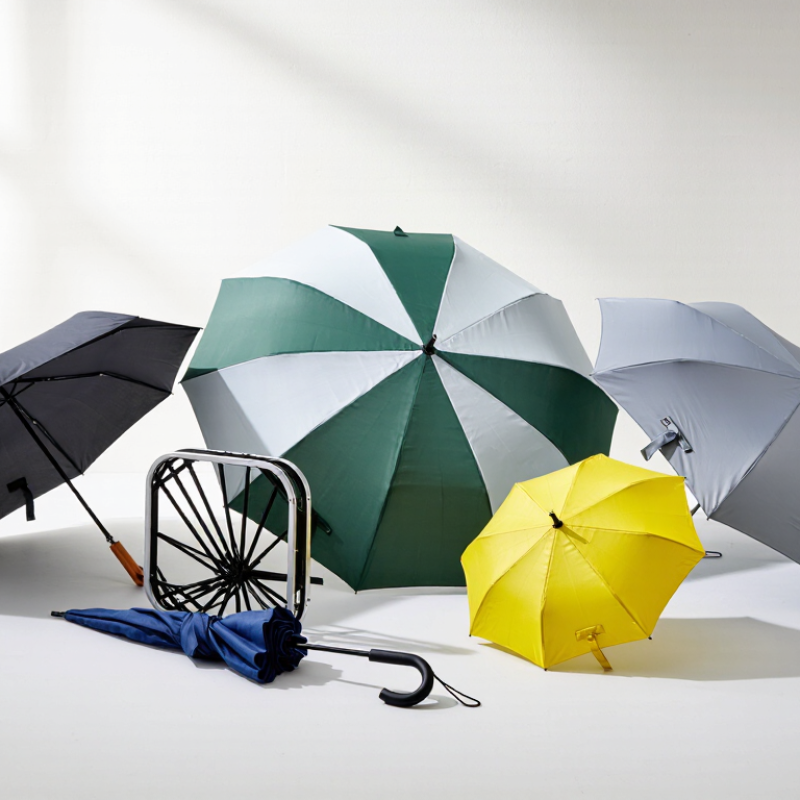
China’s umbrella factories produce several rain-umbrella types for global buyers. Compact folding umbrellas suit commuters and online retail because they fit easily into handbags and backpacks. Straight umbrellas provide stronger shafts and larger canopies for daily walking. Golf umbrellas cover two people, but their longer ribs increase shipping volume. Space matters.
Automatic open-and-close models save time in crowded streets, while manual models usually offer simpler construction and easier maintenance. Reverse-folding umbrellas reduce dripping when users enter cars or offices. Transparent canopies improve visibility at crossings, although their plastic films may scratch after repeated folding. Children’s umbrellas need rounded tips, stable frames, and age-appropriate dimensions. These details should be checked through physical samples, not only catalog photos.
Grand View Research estimated the global umbrella market at about USD 7.1 billion in 2023, with continued growth expected through 2030. This demand supports China’s broad manufacturing base, from polyester canopies to fiberglass ribs and automated assembly. However, specifications vary widely between factories. A heavier frame is not automatically stronger.
Buyers should test wind resistance, opening cycles, seam waterproofing, handle comfort, and packed size. In practical inspections, a few umbrellas may pass easily while others show loose ribs or uneven coating. That inconsistency is easy to overlook, and it deserves more attention before mass production.
Evaluating Chinese umbrella manufacturers requires more than comparing quotations. Begin with factory experience, production scale, and product specialization. Ask how many years they have made rain umbrellas. Request recent production photos, workshop videos, and sample records. A clean showroom is useful, but it is not proof of stable quality.
Inspect the umbrella closely. Check canopy stitching, fabric coating, rib alignment, shaft strength, and handle comfort. Open and close each sample repeatedly. Test it under simulated rain and moderate wind. Ask for measured waterproofing results, colorfastness data, and opening-cycle records. Confirm whether inspections occur during production, not only before shipment. Small details matter.
Review their communication and documentation. Reliable manufacturers provide clear specifications, material options, packaging details, and realistic lead times. They should explain defect rates and replacement procedures without vague promises. Verify whether raw materials can be traced to approved suppliers. Independent pre-shipment inspections add useful evidence. They also add cost.
Do not choose the lowest price too quickly. Cheap ribs may bend after several uses, while thin coatings can leave damp spots around seams. I once treated a polished sample as sufficient evidence; that was too optimistic. A sample may be carefully selected. Visit the facility when possible, or use an independent auditor. Also compare pilot-order results with later production. Quality can drift quietly.
China Top Rain Umbrella Manufacturers for Global Buyers
Quality Standards, Materials, and Production Capabilities
When evaluating Chinese rain umbrella manufacturers, buyers should inspect more than product photos. A capable supplier can explain fabric weight, frame structure, coating performance, and testing procedures clearly. Polyester pongee is widely used because it balances cost, strength, and quick drying. Recycled polyester may support sustainability goals, but its finish must still resist peeling and color fading.
Check the frame carefully. Fiberglass ribs provide flexibility during strong gusts, while steel shafts offer firmness and lower cost. Aluminum reduces weight, though weaker joints can affect durability. Reliable factories test opening cycles, rib strength, water resistance, and colorfastness. Some also conduct wind tests with controlled equipment. Ask for recent inspection records, not only sample reports.
Production capacity matters during seasonal demand. A professional facility should manage fabric cutting, printing, stitching, frame assembly, inspection, and packing in defined stages. Buyers should review daily output, workforce training, and defect-control methods. Small details reveal much: straight seams, smooth runners, secure tips, and handles without sharp edges.
No supplier should promise perfect performance. Real conditions vary. Even a strong umbrella may fail under extreme wind or careless handling. I would request pre-production samples, a pilot order, and carton drop testing before large-volume purchasing. One weakness remains common: factories sometimes measure output better than long-term field performance. That gap deserves direct questions.
Quality standards, materials, and production capabilities are key factors when sourcing rain umbrellas from China. Common canopy materials include polyester pongee, nylon, and recycled polyester. Buyers should also review fabric UV performance, water resistance, seam quality, frame durability, printing consistency, and final inspection procedures.
The chart shows the recognized UPF classification thresholds used for textile sun-protection testing: Good Protection starts at UPF 15, Very Good Protection at UPF 25, and Excellent Protection at UPF 40. Global buyers can combine these benchmarks with ISO 811 water-resistance testing, fabric composition verification, frame and rib inspections, and documented quality-control procedures.
Choosing a reliable rain umbrella manufacturer in China requires more than comparing unit prices. Global buyers should examine factory experience, production capacity, and quality control records. Ask for product samples before placing a large order. Check canopy stitching, frame strength, handle comfort, and automatic opening performance. Small defects often become expensive after shipment.
Customization usually covers canopy colors, printed logos, handles, packaging, and carton markings. Share artwork in clear vector files and confirm the exact color reference. Request a pre-production sample with the final materials. A 100-centimeter canopy may suit daily city use, while a larger golf umbrella needs stronger ribs and wider cartons. Custom packaging can improve shelf presentation, but it also increases volume and freight costs.
Export planning needs practical attention. Confirm the umbrella’s packed dimensions, gross weight, carton quantity, and shipping port before requesting quotations. Ask whether the price includes standard export packaging, inspection support, or document preparation. Buyers should also agree on payment stages, lead time, replacement terms, and acceptable defect rates in writing. A factory may promise delivery in 20 days, yet peak-season production can cause delays. Plan with a buffer.
Request inspection photos from random cartons, not only perfect samples. Third-party checks can verify quantity and workmanship before loading. One overlooked issue remains common: dark umbrellas may look correct indoors but show uneven printing in sunlight. Clear communication reduces this risk, although it cannot remove every mistake.
| Evaluation Dimension | Common Product or Service Data | Typical Buyer Requirement | Ordering and Customization Considerations | Export Considerations |
|---|---|---|---|---|
| Umbrella Type | Straight umbrella Folding umbrella Automatic umbrella Golf umbrella | Selection depends on portability, canopy coverage, wind performance, and target retail price. | Confirm the closed length, open diameter, number of folds, opening mechanism, and intended user group before requesting quotations. | Product dimensions and packed volume strongly affect carton quantity and international freight cost. |
| Canopy Diameter | Compact models commonly measure approximately 90–105 cm open; full-size models are commonly about 105–125 cm; golf styles may exceed 130 cm. | Compact sizes suit urban commuters, while larger canopies provide greater coverage for two people or outdoor use. | Ask for both the straight-line diameter and arc diameter because suppliers may quote these measurements differently. | Confirm the declared product dimensions on the packing list and commercial invoice. |
| Canopy Fabric | Common materials include polyester, pongee polyester, recycled polyester, and nylon. Polyester and pongee are widely used for promotional and retail umbrellas. | Buyers usually evaluate water repellency, colorfastness, tear resistance, fabric weight, and appearance. | Specify fabric composition, weave, coating, color reference, logo position, and required test method in the purchase order. | Material descriptions should be consistent across the product specification, invoice, packing list, and customs documentation. |
| Frame and Ribs | Common frame materials include steel, aluminum, fiberglass, and combinations of metal and fiberglass. Fiberglass ribs are valued for flexibility and corrosion resistance. | Wind resistance, weight, durability, and retail price are the main selection factors. | Define shaft material, rib count, rib material, runner type, and the required opening and closing cycle test. | Metal components may increase product weight, while fiberglass components can reduce corrosion concerns during humid or maritime transport. |
| Opening Mechanism | Manual, automatic-open, and automatic-open-and-close mechanisms are common in the market. | Manual mechanisms generally reduce cost; automatic mechanisms improve convenience but add components and testing requirements. | Request a sample showing the exact button, spring, runner, and locking mechanism intended for mass production. | Battery-powered or electronically assisted products require additional transport and regulatory review; standard mechanical umbrellas generally do not. |
| Handle and Accessories | Handles may be made from plastic, rubberized materials, wood, aluminum, or other finished materials. Accessories may include sleeves, wrist straps, tips, and storage bags. | Handle comfort, grip, scratch resistance, odor, and visual consistency are common quality checkpoints. | Approve handle drawings, color samples, surface finish, logo method, strap length, and sleeve dimensions before production. | Wooden handles or decorative materials may require additional documentation or destination-country import checks. |
| Printing and Branding | Common decoration methods include screen printing, heat transfer, digital transfer, sublimation, woven labels, and printed packaging. | Single-position printing is usually simpler; multi-panel artwork requires accurate panel alignment and color approval. | Provide vector artwork, color references, print dimensions, placement drawings, and a pre-production sample approval process. | Buyers should confirm that artwork, packaging text, care information, and regulatory markings comply with the destination market. |
| Typical Order Quantity | Factory minimum order quantities vary widely. Standard-color products may accept lower quantities than fully customized products. | Buyers should compare the unit price, tooling or setup fees, sampling cost, and packaging cost together. | Request separate quotations for stock products, custom colors, custom printing, custom handles, and custom packaging. | Small orders may have a higher per-unit freight cost and may be more suitable for consolidated shipments. |
| Sampling | Samples are commonly used to verify size, fabric, color, mechanism, printing, packaging, and workmanship before bulk production. | A production-representative sample is more useful than a visually similar stock sample when the order is customized. | Record sample approval in writing and define which characteristics may not change during mass production. | Confirm whether sample freight, duties, and sample fees are refundable or creditable against a later bulk order. |
| Production Lead Time | Lead time depends on product complexity, material availability, order quantity, decoration, packaging, and the production calendar. | Buyers should obtain a written schedule covering sample approval, material purchasing, production, inspection, and dispatch. | Include an agreed shipment window and a process for handling delays caused by artwork changes or late approvals. | Production lead time is separate from ocean, air, rail, trucking, customs-clearance, and final-delivery time. |
| Quality Inspection | Useful checks include canopy dimensions, opening and closing operation, frame alignment, fabric defects, water repellency, color consistency, logo placement, and carton quantity. | Inspection criteria should be measurable and agreed before production begins. | Use an approved sample, written specification, defect classification, and inspection report for final acceptance. | Third-party inspection can be arranged before shipment when the buyer needs independent verification. |
| Packaging | Typical packaging includes an individual sleeve or polybag, inner cartons, and export cartons. Packaging may be customized for retail or promotional distribution. | Packaging should protect the canopy and frame while controlling dimensional weight and carton volume. | Specify inner-pack quantity, carton quantity, carton dimensions, gross weight, net weight, carton marks, and barcode requirements. | Ask for a carton drop-test or transport-packaging evaluation when the shipment will pass through multiple distribution stages. |
| Shipping Terms | Common Incoterms® 2020 options include EXW, FOB, FCA, CIF, CPT, DAP, and DDP, subject to the transaction structure. | FOB or FCA may provide clearer control over the main international freight booking; DAP or DDP may simplify delivery but requires careful tax and customs review. | State the named place or port precisely and confirm which party handles export clearance, freight, insurance, import clearance, duties, and taxes. | Incoterms® do not determine product compliance, ownership transfer in every legal context, or the full scope of customs obligations. |
| Export Documents | Common documents may include a commercial invoice, packing list, transport document, certificate of origin when applicable, and inspection or test records when required. | Document requirements depend on the buyer's country, transport mode, payment method, and customs procedure. | Ensure that product descriptions, quantities, weights, values, consignee information, and shipping marks match across all documents. | Buyers should confirm destination-country requirements with their customs broker or importing authority before shipment. |
| HS Classification | Umbrellas are generally covered under HS heading 6601, but the complete tariff subheading can vary by product characteristics and destination tariff schedule. | Correct classification supports accurate duty calculation and reduces customs-clearance risk. | Provide the customs broker with the product construction, intended use, materials, and photographs rather than relying only on a general product name. | The importer of record is generally responsible for confirming the final classification and applicable import charges in the destination market. |
| Payment and Contract Controls | Commercial arrangements may use deposits and balance payments linked to production or inspection milestones, subject to buyer-supplier agreement. | Payment terms should match the buyer's risk tolerance, order size, and verification process. | Include product specifications, approved artwork, tolerances, delivery date, inspection rights, packaging requirements, and remedy terms in the contract. | Verify the legal entity, bank details, beneficiary information, and export documentation before transferring funds. |
| Sustainability Options | Possible options include recycled polyester fabric, reduced packaging, repairable components, FSC-certified wood where applicable, and longer-life frame materials. | Sustainability claims should be supported by traceable material information or recognized documentation. | Define the recycled-content percentage, certification requirement, packaging composition, and claim wording before artwork approval. | Environmental labeling and extended producer responsibility rules vary by destination market and product category. |

Sign up for our mailing list to stay informed and up to date with our latest news and products!
(905) 832 – 0600
2175-A Teston Road
Maple, Ontario
L6A 1T3
(780) 451 – 0238
24790 – 117 Avenue
Acheson, Alberta
T7X 6C2
(604) 882 – 1564
9511 – 194A Street
Surrey, British Columbia
V4N 4G4
(306) 955 – 6005
3926 Arthur Rose Avenue Saskatoon, Saskatchewan
S7P 0C9
(450) 687 – 2721
2750 Rue Bernard-Lefebvre
Laval, Quebec
H7C 0A5