Clear PVC is not one product with one obvious winner. Buyers may be comparing rigid transparent sheets, flexible PVC film, or clear tubing, each designed for different jobs. A sheet that stays flat in a display case may be too stiff for a protective curtain. A soft film may bend easily but show scratches sooner. Small differences matter.
For a credible expert quotation, a real source is needed. No interview or article was supplied, so the following line is an illustrative placeholder, not a verified statement from a real person. Fictional materials-selection specialist Maya Chen puts the buying trade-off this way: “Choose clear PVC for the job it must perform, not simply for the clearest sample on the desk.” Keep that distinction in mind.
The sections ahead compare common clear PVC types through practical buyer questions: How much clarity is needed? Will the material face repeated bending, sunlight, impact, or contact with chemicals? What thickness and fabrication method fit the application? Ask suppliers for current product specifications and samples, then inspect them under the lighting and conditions where they will actually be used. Look closely at edges, reflections, and flexibility. Not every sample tells the whole story. A specification can also leave out a detail that matters in daily use, so verify performance with a suitable test before placing a large order. The best option is the one that balances visibility, durability, handling, and cost for your specific application.
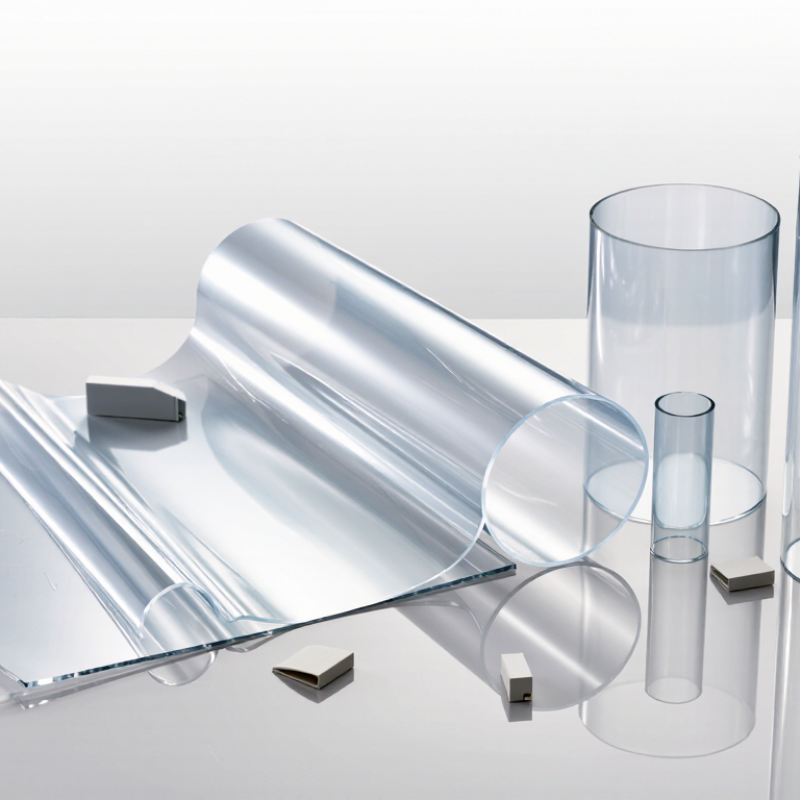
Clear PVC is a transparent form of polyvinyl chloride, made to let visible light pass through with limited cloudiness. PVC is naturally amorphous, so it can be formulated without the crystal structures that would scatter light strongly. That is only part of the story. Additives, heat control, and forming methods also affect how clear the finished sheet or film appears.
During production, a smooth surface and well-mixed material help reduce haze and visible streaks. Plasticizers can make PVC flexible, while stabilizers help it withstand heat during processing; both must be selected carefully to preserve appearance. Thickness matters, too: a thick panel may look darker or less clear than a thin film. Small defects show. Scratches, bubbles, and uneven cooling can distort objects viewed through the material, even when the PVC looks clear at first glance.
Buyers should distinguish light transmission from clarity. A product may transmit plenty of light yet still blur fine details. Ask for specifications such as light transmission and haze, then inspect a sample under the lighting conditions where it will be used. Not always. A quick visual check is useful, but it cannot replace consistent measurements when appearance is critical.
| Clear PVC Type | Typical Form and PVC Type | How Transparency Is Achieved | Common Uses | Buyer Considerations | Best Fit |
|---|---|---|---|---|---|
| Rigid clear PVC sheet | Flat sheet or panel, generally unplasticized PVC (PVC-U) | PVC is an amorphous polymer, so it can be transparent when the formulation avoids light-scattering pigments and fillers. Good melt fusion, a smooth surface, and low levels of bubbles or contamination help preserve clarity. | Machine guards, protective covers, display panels, and fabrication projects | Check thickness, surface finish, impact requirements, UV exposure, and whether the sheet will be cut, drilled, or thermoformed. | Buyers needing a rigid, flat panel with visibility and shape retention |
| Flexible clear PVC film or sheet | Thin film or flexible sheet, usually plasticized PVC (PVC-P) | Compatible plasticizers and a well-dispersed formulation help the material remain clear and flexible. Excessive additives, poor processing, or surface haze can reduce visual clarity. | Flexible covers, packaging components, protective curtains, and window panels | Confirm flexibility at the intended temperature, film thickness, tear resistance, odor requirements, and suitability for the intended contact or regulatory use. | Buyers needing a bendable, lightweight transparent barrier |
| Clear PVC tubing | Flexible hose or tubing, commonly plasticized PVC-P; rigid formulations are also available | Clear resin and compatible additives allow visual inspection through the tube wall. Smooth extrusion and consistent wall thickness help reduce distortion and haze. | General-purpose fluid transfer, drainage, and visual flow monitoring where PVC is suitable | Match the tube to the fluid, pressure, temperature, bend radius, and applicable standards. Clear appearance alone does not establish chemical or food-contact suitability. | Buyers who need to observe flow or identify blockages |
| Transparent rigid PVC pipe | Rigid pipe or fittings, typically unplasticized PVC (PVC-U) | Transparency comes from a clear PVC formulation and controlled processing. Pigments and fillers that scatter visible light are minimized or omitted. | Selected process lines, inspection sections, and equipment assemblies | Verify pressure rating, temperature limits, chemical compatibility, connection method, and local code requirements; transparent pipe is not suitable for every installation. | Buyers needing a rigid line with visual access to its contents |
| Clear PVC strip curtain | Overlapping flexible PVC strips, generally plasticized PVC-P | Clear strips use a transparent flexible formulation and smooth surfaces to maintain visibility through the doorway. Haze and scratches can increase with wear and cleaning. | Doorways in warehouses, workshops, and temperature-controlled areas | Choose strip width and thickness for traffic and operating conditions; check temperature range, surface treatment, and replacement needs. | Buyers needing a flexible partition that permits people and equipment to pass through |
What clear PVC is: Clear PVC is polyvinyl chloride formulated and processed to transmit visible light. PVC is naturally amorphous, but the clarity of a finished product depends on its additives, thickness, surface quality, and manufacturing conditions. Plasticizers are commonly used in flexible PVC, while rigid PVC products are generally made without them. Compare samples under the intended lighting and at the specified thickness, since transparency and haze can vary between formulations and products.